
By Kiran Aradhaya, Law student and author | Samvada.org
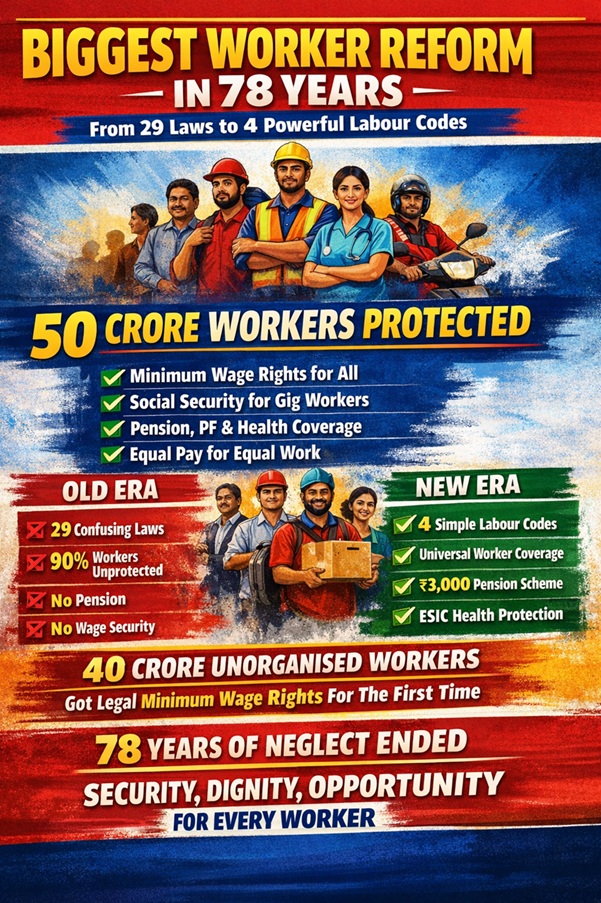
For decades, India’s labour laws were trapped in a maze of 29 legislations, many drafted in 1940’s, a different economic era. Complex, overlapping, and often contradictory, they created confusion for employers and uncertainty for workers. The result was litigation, inspector raj, compliance headaches, and millions of workers left outside real protection.
The Government of India’s decision to consolidate them into four modern labour codes was not cosmetic reform. It was structural reform.
For decades, India’s labour laws were trapped in a maze of 29 legislations, many drafted in 1940’s, a different economic era. Complex, overlapping, and often contradictory, they created confusion for employers and uncertainty for workers. The result was litigation, inspector raj, compliance headaches, and millions of workers left outside real protection.
The Government of India’s decision to consolidate them into four modern labour codes was not cosmetic reform. It was structural reform.
The four pillars, the Code on Wages, 2019, the Industrial Relations Code, 2020, the Code on Social Security, 2020, and the Occupational Safety, Health and Working Conditions Code, 2020, mark the most comprehensive labour overhaul since Independence. Contrary to the fear-mongering, these reforms strengthen workers, not weaken them. Here I explain:
Ending Wage Manipulation
The Code on Wages, 2019 brings in a uniform definition of wages. For years, companies artificially lowered basic pay and inflated allowances to reduce provident fund and gratuity payouts. Workers lost in the long term. Now, basic salary must form at least 50 percent of total remuneration. This means:
- Higher PF contribution
- Higher gratuity accumulation
- Stronger retirement savings
Yes, monthly take-home may slightly adjust due to higher PF deductions. But long-term financial security improves. Reform is about sustainability, not short-term optics. More importantly, the concept of a national floor wage ensures that no worker is pushed below a statutory threshold. This is not dilution. This is expansion.
Bringing Gig Workers into the Legal Framework
For the first time in Indian history, gig and platform workers are formally recognised under the Code on Social Security, 2020. Millions who power food delivery apps, ride-hailing services, and digital platforms were invisible in labour law. No defined safety net. No structured welfare framework. Now, the law provides for social security schemes for gig and unorganised workers. It creates the foundation for insurance, pension-like models, and welfare funds.
For the first time in Indian history, gig and platform workers are formally recognised under the Code on Social Security, 2020. Millions who power food delivery apps, ride-hailing services, and digital platforms were invisible in labour law. No defined safety net. No structured welfare framework. Now, the law provides for social security schemes for gig and unorganised workers. It creates the foundation for insurance, pension-like models, and welfare funds.
How can this be anti-labour? This is modern labour inclusion.
Contract Workers No Longer Second-Class
Under earlier laws, fixed-term employees (Contract Workers) often missed out on long-term benefits. Now, gratuity can be paid on a pro-rata basis even without completing five years. That is a major structural correction.
Labour reform should not only protect permanent workers. It must adapt to modern employment patterns. India’s economy is evolving. The law must evolve with it.
Workplace Safety and Documentation
The Occupational Safety Code,2020 consolidates 13 separate laws into one clear framework. Mandatory appointment letters.
The Occupational Safety Code,2020 consolidates 13 separate laws into one clear framework. Mandatory appointment letters.
- Defined working conditions.
- Stronger health and safety compliance.
- Registration of inter-state migrant workers.
For migrant labour, often the most exploited, formal registration creates accountability. It reduces anonymity and strengthens enforceability.
Industrial Relations Stability for Growth
The Industrial Relations Code, 2020 has drawn criticism, particularly regarding the revision of layoff and retrenchment thresholds. However, a proper comparison with the earlier regime under the Industrial Disputes Act, 1947 is necessary before arriving at conclusions.
The Industrial Relations Code, 2020 has drawn criticism, particularly regarding the revision of layoff and retrenchment thresholds. However, a proper comparison with the earlier regime under the Industrial Disputes Act, 1947 is necessary before arriving at conclusions.
Earlier Position Under the Industrial Disputes Act, 1947:
- Establishments employing 100 or more workers were required to obtain prior government permission before effecting layoff, retrenchment or closure.
- Delays in administrative approval were common.
- Permission was often uncertain and subject to discretionary decision-making.
- Industrial disputes frequently resulted in prolonged litigation before Labour Courts and Industrial Tribunals.
The consequence was regulatory rigidity. Many enterprises deliberately kept workforce strength below 100 to avoid falling within the statutory threshold. This created:
- Artificial caps on employment
- Avoidance of workforce expansion
- Informalisation of labour
- Increased contractual hiring instead of permanent employment
Position Under the Industrial Relations Code, 2020
The threshold for prior government approval has now been revised to 300 workers. What has changed:
The threshold for prior government approval has now been revised to 300 workers. What has changed:
- Mid-sized firms employing between 100 and 299 workers are no longer subject to mandatory prior permission for retrenchment.
- However, statutory compensation remains mandatory.
- Notice requirements remain intact.
- Procedural safeguards have not been abolished.
Recognition of Negotiating Union
Earlier, multiplicity of trade unions within the same establishment often led to fragmented representation and industrial paralysis. The new Code introduces:
Earlier, multiplicity of trade unions within the same establishment often led to fragmented representation and industrial paralysis. The new Code introduces:
- Formal recognition of a “negotiating union” where a trade union secures majority support.
- In the absence of majority, a negotiating council is constituted.
This creates clarity in collective bargaining. Instead of multiple unions making competing demands, a structured negotiation mechanism is provided. This reduces industrial deadlock.
Predictability Is Not Anti-Worker
Industrial stability reduces strikes driven by procedural ambiguity. Structured recognition of negotiating unions reduces factional conflict. Clear thresholds reduce compliance uncertainty. Stability promotes investment. Investment promotes expansion. Expansion generates employment. Industrial predictability is not anti-worker. It is pro-employment.
Industrial stability reduces strikes driven by procedural ambiguity. Structured recognition of negotiating unions reduces factional conflict. Clear thresholds reduce compliance uncertainty. Stability promotes investment. Investment promotes expansion. Expansion generates employment. Industrial predictability is not anti-worker. It is pro-employment.
A rigid system that discourages job creation cannot be described as pro-labour merely because it is restrictive. True worker empowerment lies in combining protection with opportunity. The Industrial Relations Code attempts precisely that balance.
The Larger Vision
India cannot compete globally with a labour regime designed for the 1970s. We are in the era of:
India cannot compete globally with a labour regime designed for the 1970s. We are in the era of:
- Digital platforms
- Supply chain manufacturing
- Mobile workforce
- Global investment flows
The old framework excluded gig workers, over-regulated compliant firms, and left the informal sector largely untouched. The new codes expand coverage, formalise employment, standardise compliance, and reduce inspector-driven arbitrariness. That is reform with intent.
The Politics of Fear vs Policy of Reform
Every structural reform face resistance. It is easier to mobilise fear than to explain change. But let us be clear. These codes do not abolish worker rights. They modernise them. They expand social security. They bring transparency to wage structures. They strengthen retirement savings. They formalise migrant labour.
Every structural reform face resistance. It is easier to mobilise fear than to explain change. But let us be clear. These codes do not abolish worker rights. They modernise them. They expand social security. They bring transparency to wage structures. They strengthen retirement savings. They formalise migrant labour.
The choice before India was simple:
Remain trapped in outdated legal fragmentation, or move toward a unified, modern labour ecosystem.
The Government chose reform.
In the long run, workers will benefit not from slogans, but from structure. Labour empowerment is not achieved by preserving chaos. It is achieved by building clarity, inclusion, and long-term security. India’s Labour Codes are not perfect. No reform ever is. But they are necessary. They are forward-looking. This is not an anti-worker policy. This is pro-worker reform for a modern economy.